
The Truth Behind Andy Griffith’s Wholesome Image
Andy Griffith was a major figure in American television. He became widely known for playing Andy Taylor on The Andy Griffith Show, a role that captured everyday small-town life in a way that felt familiar to millions of viewers. Beyond that single role, Griffith’s work helped shape TV comedy and storytelling for decades.
His natural delivery and understated humor influenced many actors and comedians who followed.
Andy Griffith Was a Natural Performer From the Start

Andy Griffith was born on June 1, 1926, in Mount Airy, North Carolina. He grew up in a modest, close-knit town that later became the model for the fictional Mayberry. His father, Carl Lee Griffith, worked as a carpenter, and his mother, Geneva Nunn Griffith, was a homemaker.
The family struggled financially in Griffith’s early years, and as an infant he reportedly slept in a dresser drawer, due to limited space. As a child, he showed a strong interest in music, learning to play the trombone and singing in his church choir. These experiences shaped his path toward a career in performance.
The Early Years That Shaped His Career

After graduating from high school, Andy enrolled at the University of North Carolina at Chapel Hill, where he initially studied to become a Moravian preacher, before shifting his focus to music. He earned a bachelor’s degree in music in 1949 and became deeply involved in campus theater.
While at UNC, Griffith performed in student productions and developed the storytelling style and comic timing that would later define his career. His training in music and theater gave him a solid foundation, preparing him for the stage, film and TV work that followed.
Andy Griffith Steps Into the Spotlight

Andy Griffith’s career took a decisive turn in 1955, when he starred in the TV production No Time for Sergeants as Will Stockdale, a naïve but good-natured US Air Force recruit. The role highlighted his natural comedic timing and plainspoken delivery, drawing national attention.
Griffith reprised the role on Broadway and, again, in the 1958 film adaptation, helping establish him as a dependable comedic lead. His performance relied less on exaggeration and more on warmth and authenticity - traits that would remain central to his work in TV and film.
The Show That Defined His Television Career

Premiering in 1960, The Andy Griffith Show quickly became a television staple, capturing the hearts of viewers with its portrayal of small-town life. Set in the fictional town of Mayberry, the series followed Sheriff Andy Taylor, played by Griffith, and his interactions with the town's quirky residents.
The show's success was largely due to its relatable characters and wholesome humor. Over its eight-season run, it garnered critical acclaim and remains a beloved classic, illustrating the timeless appeal of Griffith's storytelling.
Behind the Scenes in Mayberry

The Andy Griffith Show had plenty of stories behind the camera, as well. The show’s well-known opening sequence, with Andy and Opie walking to the fishing hole, was filmed at Franklin Canyon Park in Los Angeles, not in North Carolina, as many viewers assumed.
Don Knotts, who played Barney Fife, originally signed on for just five episodes. His on-screen chemistry with Griffith quickly stood out, however, and he was made a regular cast member.
Details like these offer a clearer picture of how the show came together and why it left such a lasting impression.
An Opening Viewers Never Forgot

The whistling theme from The Andy Griffith Show, titled “The Fishin’ Hole,” became one of the most recognizable TV themes of its time. The music was composed by Earle Hagen, with lyrics by Herbert W. Spencer, and Hagen himself performed the whistling heard in the opening credits.
The simple melody matched the show’s relaxed pace and small-town setting, helping set expectations for what viewers were about to see. Decades later, the theme remains closely associated with Mayberry and the series as a whole.
A Career Shift That Changed Everything

After The Andy Griffith Show came to an end, Andy Griffith returned to TV in a very different role. In 1986, he starred in the legal drama Matlock, playing Ben Matlock, a sharp but unassuming defense attorney. The role allowed him to move away from comedy and prove that he could carry a serious, hour-long drama.
Matlock ran for nine seasons and introduced Griffith to a new generation of viewers. Its success showed he could adapt to changing audiences while still relying on the calm, likeable presence that had defined his earlier work.
When Griffith Turned to Music

Andy’s interest in music ran alongside his acting career. In 1959, he recorded What It Is, Is Andy Griffith, a spoken-word comedy album that became a major success and hit No. 1 on the Billboard charts.
He also recorded several gospel albums, including Precious Memories, reflecting his lifelong connection to church music. Whether through comedy or hymnals, Griffith used music as another way to tell stories and reach audiences beyond TV.
Griffith’s Impact on American Pop Culture

Griffith's work continues to have a strong presence in American popular culture. The Andy Griffith Show and Matlock remain staples in syndication, bringing his performances to new audiences decades after their original runs.
His understated delivery and plainspoken humor influenced generations of actors and comedians. By presenting small-town life without exaggeration or irony, Griffith shaped a style of TV that valued character, simplicity and quiet humor, an approach that continues to resonate today.
Looking Back on Andy Griffith’s Career

Andy Griffith’s work was recognized with several major honors over the course of his career. In 1997, he won a Grammy Award for Best Southern, Country or Bluegrass Gospel Album for I Love to Tell the Story: 25 Timeless Hymns. His contributions to American TV were further acknowledged in 2004, when he received Kennedy Center Honors.
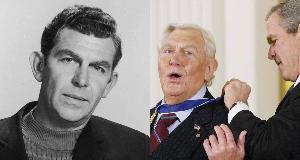
In 2005, Griffith was awarded the Presidential Medal of Freedom, one of the nation’s highest civilian honors, in recognition of his influence on American culture. Together, these awards reflected the breadth of his career and the lasting impact of his work on entertainment.
His Life Beyond the Spotlight

Despite his public profile, Andy kept his personal life largely private. He married his first wife, Barbara Edwards, in 1949, and the couple adopted two children, Sam and Dixie. The marriage ended in divorce in 1972, though Griffith remained involved in his children’s lives.
Griffith later married actress Solica Casuto in 1973; the marriage ended in divorce eight years later. In 1983, he married Cindi Knight, who would remain his wife until his death in 2012. The couple lived quietly in North Carolina, where Griffith lived a low-key life away from Hollywood.
His Final Years Away From the Spotlight

In his later years, Andy largely stepped away from the spotlight after a career that stretched more than six decades. He made occasional TV appearances and spent most of his time at his home in North Carolina, where he preferred a quiet routine.
Griffith died on July 3, 2012, at the age of 86.
The Enduring Legacy of Andy Griffith

Andy Griffith’s death in 2012 prompted widespread tributes from fans, colleagues and figures across the entertainment industry. Retrospectives highlighted his long career and his influence on American comedy and storytelling.
In his hometown of Mount Airy, North Carolina, Griffith is honored with a statue and the Andy Griffith Museum, which preserves memorabilia from his career.
 Devin Duke